 Aniv AI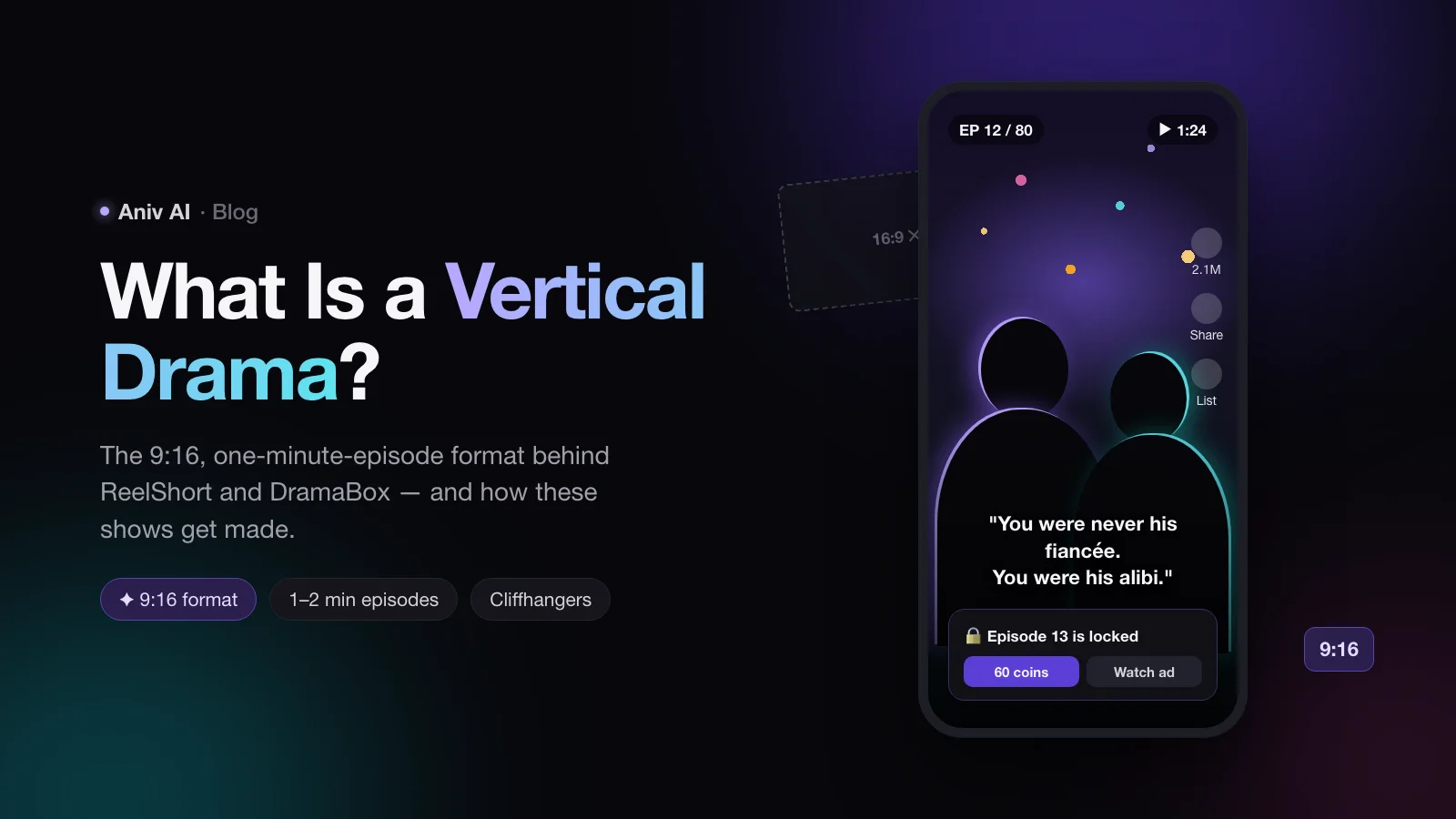
A vertical drama is a scripted series filmed in portrait (9:16) format for phones, told in episodes of roughly one to two minutes, with a cliffhanger at the end of almost every episode. A full series usually runs from a few dozen to around a hundred episodes, so a whole season adds up to about the length of a feature film — but it is watched one swipe at a time.
If you have seen ads for apps like ReelShort or DramaBox — a billionaire, a contract marriage, a slap, a reveal, "watch the next episode" — you have seen a vertical drama. The format started in China, where it is called duanju (short drama), and has become one of the fastest-growing kinds of entertainment in the world. This guide explains what defines it, where it came from, how the apps make money and how the shows are actually made.
What makes a drama "vertical"
The name refers to the screen, but the format is defined by four things together:
- 9:16 framing. Shot to fill a phone held upright, with no need to rotate it.
- Very short episodes. Typically 60 to 120 seconds — short enough to watch in a queue, long enough for one twist.
- Many episodes. A series commonly runs 20 to 100 episodes, released all at once rather than weekly.
- A cliffhanger every episode. Each episode is built to end at a moment of maximum tension, because the next episode is one swipe away.
Vertical drama, micro drama and short drama are mostly used as synonyms. "Vertical" emphasises the screen, "micro" the episode length, and "short drama" is the literal translation of the Chinese term.
Where vertical dramas came from
The format grew out of Chinese web fiction — serialised online novels with fast plots and frequent hooks — and short-video platforms. Kuaishou launched a dedicated section for these mini-series in 2019, and China's broadcasting regulator formally recognised them as a category in 2020. By the end of 2024, the Chinese market was reported at more than 50 billion yuan (around 7 billion US dollars), according to figures cited by People's Daily and CNBC.
The jump overseas came through dedicated apps. ReelShort launched in the US in 2022 and DramaBox in 2023, mostly with English-language remakes of proven Chinese storylines shot with Western casts. Variety reported that ReelShort made roughly 400 million dollars in revenue in 2024 and DramaBox 323 million. The US is now the largest market outside China, and traditional studios have taken notice: in 2025 Fox Entertainment agreed to fund more than 200 vertical series for the app My Drama, as reported by Deadline and Variety.
What vertical dramas are about
The genres are deliberately familiar, because a viewer has to understand the situation in seconds:
| Genre | The typical setup |
|---|---|
| Billionaire romance | An ordinary woman, a cold rich heir, a contract or a mistaken identity. |
| Revenge | A betrayed wife or disowned child returns, transformed, to destroy the people who wronged them. |
| Hidden identity | The humble son-in-law everyone mocks is secretly the heir, the boss or the legend. |
| Werewolf and fantasy romance | Fated mates, rejected Lunas, alpha rivals — imported from online romance fiction. |
| Family drama | Swapped babies, secret siblings, inheritance fights. |
The pleasure is less in surprise than in payoff: the audience knows the arrogant fiancé will be humiliated, and the episode exists to deliver that moment.
How vertical drama apps make money
Almost every app uses the same structure: the first episodes are free, and the rest are locked behind a paywall that appears right after a major twist.
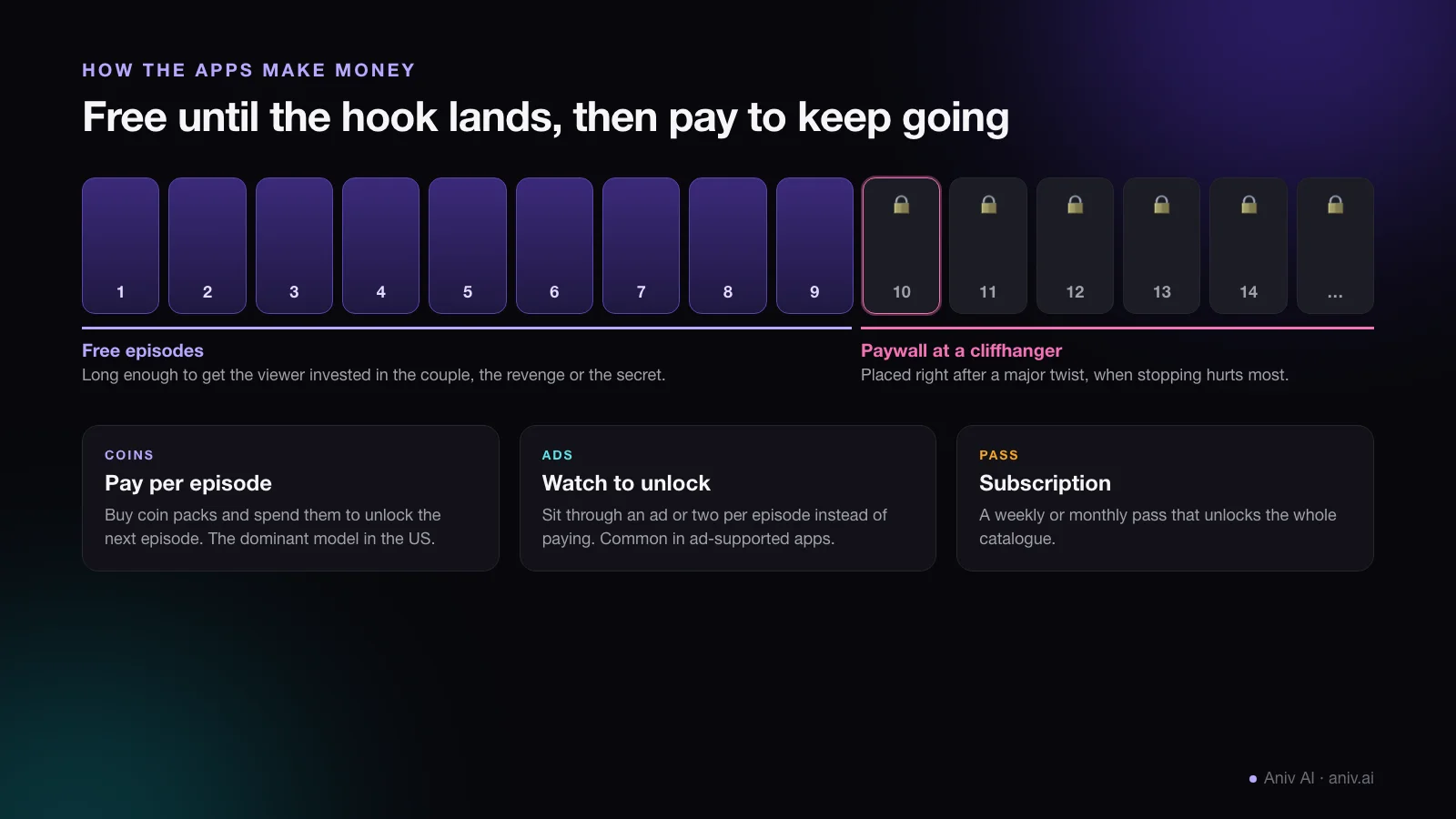
Viewers then unlock episodes in one of three ways:
- Coins. Buy a pack of in-app coins and spend them per episode. In the US this pay-per-episode model dominates; a full series can cost as much as a month of a streaming subscription.
- Ads. Watch one or more ads to unlock the next episode for free. This model is more common in Southeast Asia and Latin America, and in China ad-supported viewing overtook paid unlocks in 2025.
- Subscriptions. A weekly or monthly pass that unlocks the catalogue, usually alongside coins.
This is why the writing is so relentless. The paywall only works if the episode before it ends at a moment the viewer cannot walk away from.
Where to watch vertical dramas
The main dedicated apps are ReelShort, DramaBox, ShortMax, GoodShort, FlexTV and My Drama, all on iOS and Android. Many series also appear, in full or in part, on YouTube, TikTok, Facebook and Dailymotion — sometimes officially as promotion, sometimes not. If you want to watch for free, look for apps' ad-unlock options and daily free-coin rewards rather than unofficial uploads.
How vertical dramas are made
Live-action vertical dramas are produced fast and cheap by television standards. A US production typically shoots 50 to 70 or more episodes in seven to ten days on a budget of roughly 150,000 to 250,000 dollars, according to industry figures cited by Wikipedia. That speed shapes everything about the craft.
Writing
Scripts are written to a strict length per episode, with the cliffhanger planned first. A season is outlined in blocks — hook, commitment, escalation, collapse, payoff — with the strongest cliffhanger placed where the free episodes end. Our guide on how to write a drama script walks through the method with a full episode example.
Framing for a phone
Shooting for 9:16 is not just cropping a widescreen frame. Directors stage scenes differently:
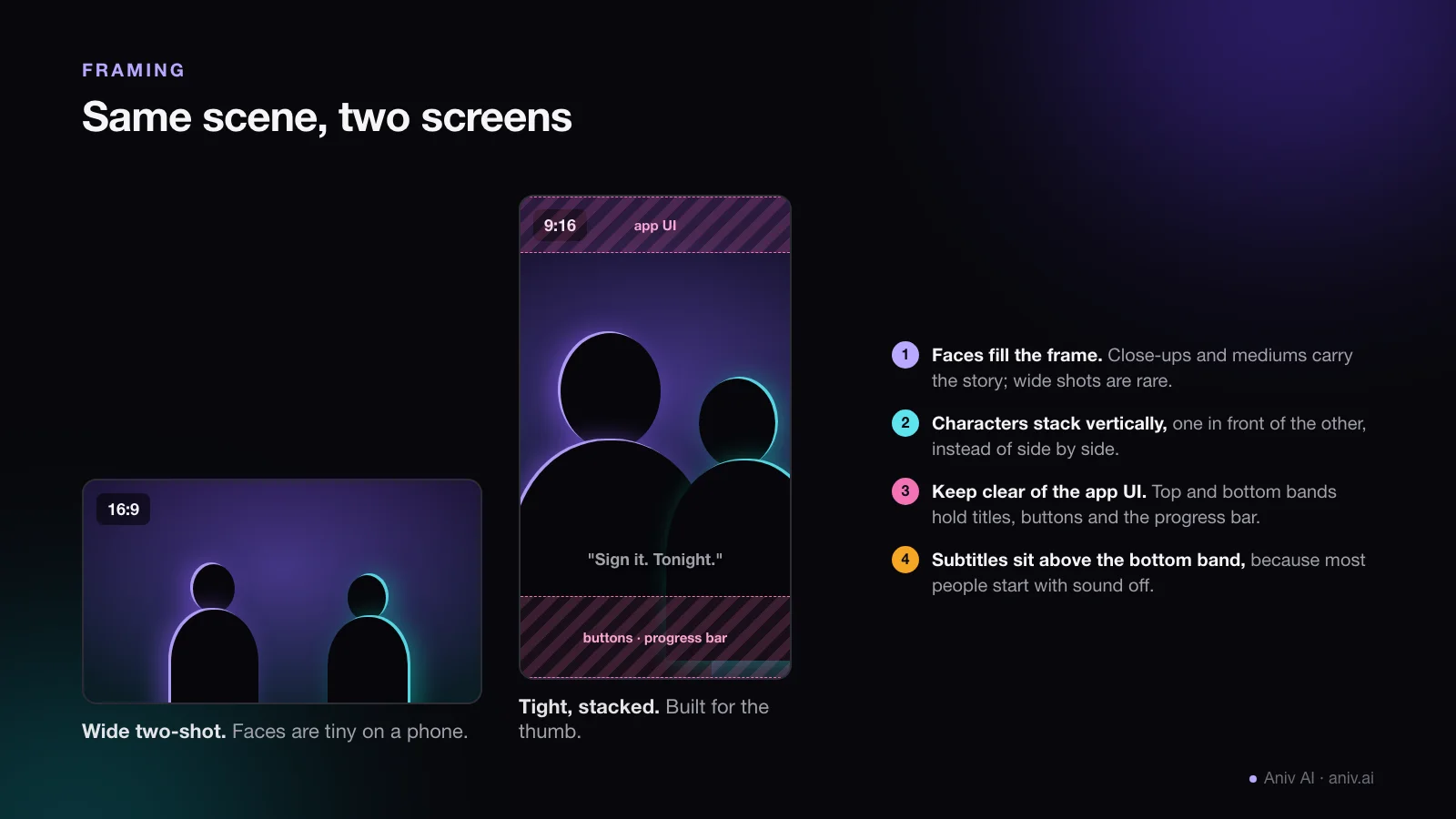
- Close-ups carry the story. Faces and reactions matter more than locations. Wide establishing shots are rare.
- Characters stack in depth. Two people talking are placed one in front of the other, not side by side.
- The top and bottom of the frame are busy. App titles, buttons and progress bars cover them, so nothing important goes there.
- Subtitles are burned in. Many viewers start with the sound off, so captions sit just above the bottom interface band.
Editing and release
Episodes are cut tight — there is rarely a shot longer than a few seconds — and the whole series is released at once. Producers then test which hooks and ad clips bring in viewers, and where the paywall converts best, and adjust.
AI-generated vertical dramas
A growing share of vertical dramas are now made partly or entirely with AI, especially fantasy and period stories that would be expensive to shoot. AI tools can draft scripts, generate consistent characters, storyboard each episode and produce the video shots, which makes it possible for a single creator or a small team to produce a series without a set.
Aniv's AI short drama generator is built for exactly this workflow: start from a one-line idea or your own script, and the same script drives the character designs, storyboards, voices and generated 9:16 video, with every episode managed in one workbench. You can see examples in the showcase gallery, or generate single shots with the AI video generator.
Vertical drama vs. traditional TV drama
| Vertical drama | Traditional TV drama | |
|---|---|---|
| Screen | Phone, 9:16 | TV or laptop, 16:9 |
| Episode length | 1–2 minutes | 40–60 minutes |
| Episodes | 20–100, released at once | 8–24 per season |
| Pacing | A twist every episode | Arcs across the season |
| Business model | Pay or watch ads per episode | Subscription, licensing, broadcast ads |
| Production | Days to a couple of weeks | Months |
Frequently asked questions
What does vertical drama mean?
It means a scripted drama series shot in vertical 9:16 format for smartphones, with very short episodes and a cliffhanger in almost every one. The term is used interchangeably with micro drama and short drama.
How long is a vertical drama episode?
Usually one to two minutes. A full series of 60 to 100 episodes typically adds up to one and a half to three hours.
Are vertical dramas free?
The first several episodes usually are. After that, most apps ask you to pay with in-app coins, watch ads, or subscribe. Some ad-supported apps let you watch whole series for free in exchange for ads.
Why are vertical dramas so popular?
They fit into the moments people already spend on their phones, they deliver an emotional payoff in a minute or two, and every episode ends on a hook designed to make the next one irresistible. The familiar genres mean viewers understand each story instantly.
Can I make my own vertical drama?
Yes. A live-action series needs a script, a small cast and crew, and a week or two of shooting. With AI tools, a single creator can write the script, generate consistent characters and produce the episodes without filming at all — see how to write a drama script for where to start.