 Aniv AI
A drama script has one job that most other writing does not: it has to make a stranger care what happens to someone they met thirty seconds ago, and then make them need to know what happens next. Explaining a product or teaching a skill can survive a slow start. A drama cannot. If the viewer does not feel a want, an obstacle and a question within the first scene, they are gone.
This guide walks through how to write a drama script from a blank page to a finished, shootable episode. It covers the decisions you make before writing any dialogue, the standard screenplay format, how to structure an episode around beats, and how to write the cliffhanger that makes people press play on the next one. The examples use the short, vertical drama format — one- to two-minute episodes — because it is the hardest to get right and the fastest-growing, but every step applies to a stage play, a web series or a feature.
What makes a drama script different
A script for a video such as an ad or an explainer is organised around a message. A drama script is organised around conflict: a character wants something, something stands in the way, and the story is what they do about it. Three consequences follow:
- Every scene needs a want and an obstacle. A scene where two people agree with each other is not a scene. Cut it or find the disagreement.
- Information is withheld on purpose. Good drama decides what the audience knows, what the characters know, and when each finds out. The gap between the two is where tension lives.
- Dialogue is action. People in dramas talk to get something — to persuade, hide, wound or test. Lines that only deliver information are the weakest lines in any script.
Step 1: Write the premise in one sentence
Before characters, before scenes, write a single sentence with four parts: a protagonist, what they want, what stands in the way, and what is at stake.
A woman forced into a three-month contract marriage with a cold heir (protagonist + situation) wants to expose the family that framed her father (want), but the heir she must fool is the only person who can find her out (obstacle) — and if he does, she loses the evidence and her freedom (stakes).
If you cannot write this sentence, the script will wander. If the sentence is boring, the script will be boring, no matter how sharp the dialogue is. Rewrite it until the obstacle feels genuinely hard and the stakes feel genuinely personal.
Where AI helps here
Premises are where volume pays off. Ask a chat assistant for twenty variations on your idea and judge them on the obstacle, not the setting:
Here is a drama premise: [premise]. Write 20 variations that keep the protagonist but change the obstacle or the stakes. Make at least five of them morally uncomfortable. One sentence each.
Most will be clichés. One or two will make the story harder for your protagonist — those are the ones to keep.
Step 2: Build characters around a contradiction
Flat characters want one thing. Memorable characters want two things that cannot both be true. For each main character, write down three lines:
- What they want — the visible goal that drives the plot.
- What they need — the thing they are wrong about, which the story will force them to face.
- What they hide — the secret that, if revealed, changes how others see them.
For the heir in our premise: he wants a quiet marriage that keeps his grandmother's shares in the family; he needs to admit his family is rotten; he hides that he already knows who framed her father. Every one of those lines is a future scene.
Keep the cast small. A short drama season can run to 80 episodes, but the audience follows two or three people. Supporting characters should each exist to put pressure on the leads — a scheming stepsister, a loyal assistant who knows too much, a rival who wants the same prize.
Step 3: Learn the screenplay format
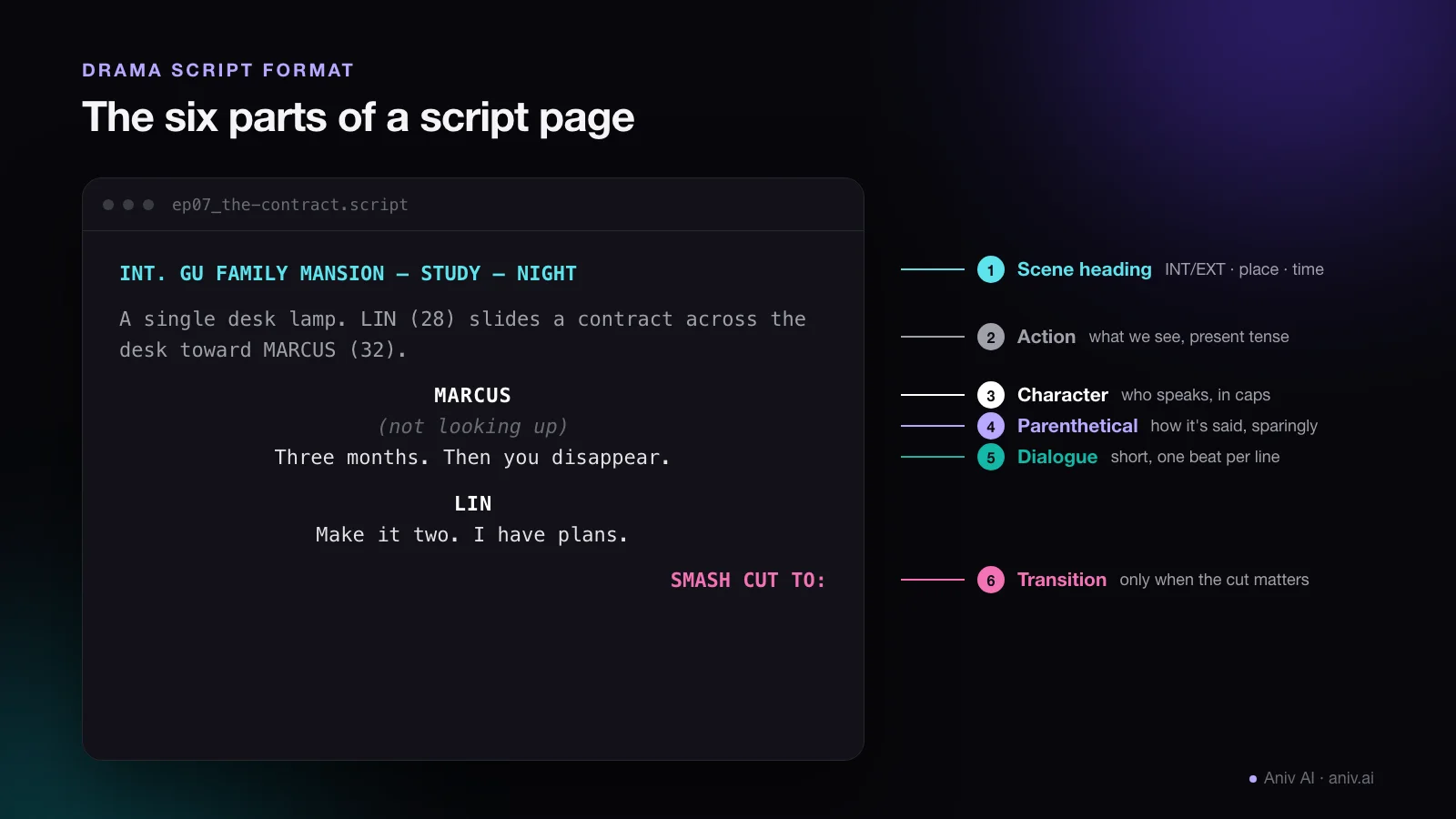
Drama scripts use a standard format so that everyone who reads them — actors, directors, editors, and now video generation tools — can find what they need at a glance. A script page has six elements:
| Element | What it does | How to write it |
|---|---|---|
| Scene heading | Says where and when the scene happens | INT. or EXT., the location, then DAY or NIGHT, in capitals |
| Action | Describes what the camera sees | Present tense, short paragraphs, only what can be filmed |
| Character | Names who is speaking | Capitals, centred above the line; capitalise a name the first time a character appears in action |
| Parenthetical | Gives a short delivery note | In brackets under the name; use rarely, never to explain the subtext |
| Dialogue | The words spoken | Centred under the name; one thought per line |
| Transition | Marks a deliberate cut | Right-aligned, e.g. SMASH CUT TO:; only when the cut itself tells the story |
Two rules matter more than the rest. First, action lines describe only what can be seen or heard: "Lin hates him" is not filmable, "Lin tears the photo in half without looking at it" is. Second, keep action paragraphs to three lines or fewer so the script reads at the speed the episode plays.
Step 4: Outline the season before writing episodes
Long-form drama falls apart in the middle. The cure is an outline that fixes the big turns before you write a word of dialogue. For a short drama season, plan in blocks:
| Block | Episodes (of ~80) | What has to happen |
|---|---|---|
| Hook | 1–3 | The inciting incident and the central relationship, fast. The premise sentence should be visible by the end of episode 1. |
| Commitment | 4–10 | The protagonist commits to the plan and the first big reveal lands. Free episodes on most apps end around here, so this block must end on the strongest cliffhanger in the season. |
| Escalation | 11–55 | Each mini-arc of five to ten episodes raises the stakes and pays off one secret while opening another. |
| Collapse | 56–70 | The lie is exposed, the alliance breaks, the protagonist loses what they gained. |
| Payoff | 71–80 | Every major secret is revealed, the villain is defeated, the relationship resolves. |
Write the outline as one line per episode: what changes in that episode and what question it ends on. If two consecutive episodes end on the same question, merge them or change one.
Step 5: Structure each episode around five beats
A beat is a single change: a new piece of information, a decision, a reversal. A 90-second episode has room for about five, and they fall in a predictable shape.
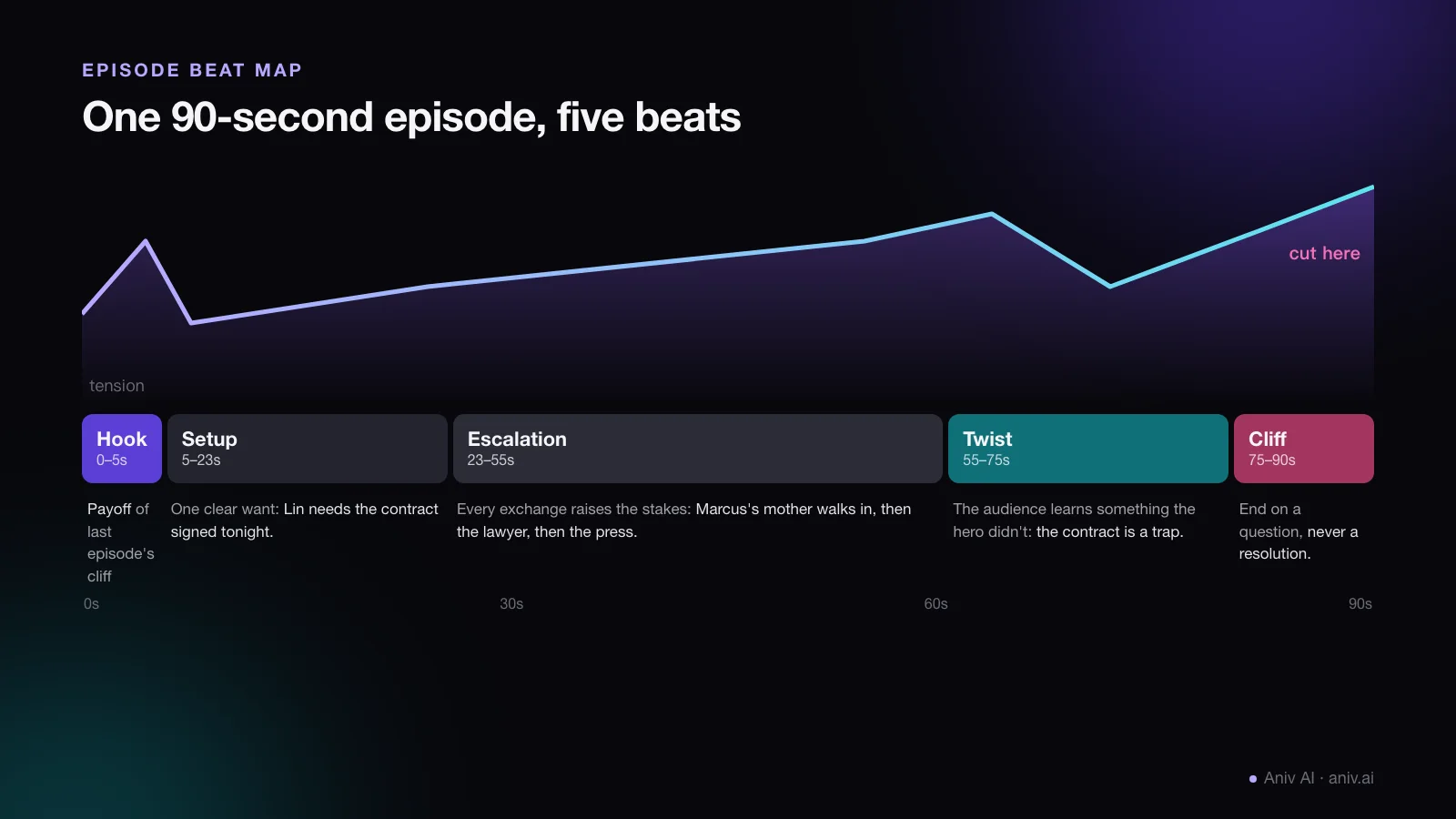
- Hook (first 3–5 seconds). Pay off the last episode's cliffhanger or open on an image that raises a question. No establishing shots, no slow walks into rooms.
- Setup. One clear want for this episode. The audience should be able to say what the protagonist is trying to do right now.
- Escalation. Each exchange makes it harder. Add a person, a deadline or a piece of bad news rather than more talk.
- Twist. Something changes the meaning of what came before: a document, a phone call, a face in the doorway.
- Cliffhanger. End on a question, a threat or a reveal — never on a resolution. The final line of action is often the cliffhanger itself.
Length gives you a budget. Spoken dialogue runs at roughly 130–160 words a minute, so a 90-second episode holds about 150–200 words of dialogue, less if there is action to watch. If your draft has 400 words of dialogue, it is two episodes.
Step 6: Write dialogue that does something
The fastest way to improve a drama script is to ask, for every line: what is this character trying to get from the other person? If the answer is "nothing, they are telling the audience something", rewrite it.
- Subtext over statement. "I'm angry that you lied" is weaker than "You took your coffee black this morning. You hate it black."
- Short lines. On a phone screen with subtitles, long speeches become walls of text. Two short sentences beat one long one.
- Interruptions and silence. People rarely finish their sentences in a fight. Write the interruption. Write the pause as action: "She doesn't answer."
- Different voices. Cover the names and read a page. If you cannot tell who is speaking, the characters are not distinct yet.
Step 7: Write the cliffhanger first
Many short drama writers write the ending of each episode before anything else, because the cliffhanger is what the episode exists to deliver. The strongest cliffhangers fall into a few patterns:
| Type | Example final beat |
|---|---|
| The reveal | The test results arrive. The father's name on them is not his. |
| The threat | A text from an unknown number: "I know what you did on the rooftop." |
| The arrival | The door opens. The woman everyone thought was dead walks in. |
| The choice | She has the evidence in one hand and his hand in the other. Cut. |
| The reversal | The man she has been fooling smiles: "I signed it because I wanted you here." |
Vary them. A season that ends every episode on "someone walks in" teaches the audience to stop caring who walks in.
A complete short drama script example
Here is a single 90-second episode written with everything above. It is episode 7 of the contract-marriage premise from Step 1.
INT. GU FAMILY MANSION – STUDY – NIGHT
A single desk lamp. LIN (28) slides a contract across the desk toward MARCUS (32), who keeps writing.
MARCUS
(not looking up)
Three months. Then you disappear.LIN
Make it two. I have plans.The door opens. MADAM GU (70) enters with a cane and a smile that does not reach her eyes.
MADAM GU
Signing contracts at midnight. How romantic.Marcus covers the contract with his hand. Lin notices the grandmother noticing.
MADAM GU
Your father signed things at midnight too, Miss Lin. Before the trial.Lin's pen stops.
LIN
You knew my father?MADAM GU
I knew his handwriting.She drops an old envelope on the desk and leaves. Lin opens it: a confession, signed with her father's name — in Marcus's handwriting.
Lin looks up. Marcus has stopped writing.
SMASH CUT TO BLACK.
Count what it does in about 130 words of dialogue and action: a want (finish the deal), escalation (the grandmother arrives), a twist (she knew Lin's father), and a cliffhanger that recasts the male lead (the forged confession is in his handwriting). Every line of dialogue is a move in a game; nobody explains anything.
Turning the script into video
A finished drama script is also a production document. Each scene heading becomes a location, each character a consistent face, each action line one or more shots. For a vertical drama, write action with a 9:16 frame in mind — close-ups and two people stacked in depth, not wide shots — as covered in what a vertical drama is.
AI tools now cover most of that path. In Aniv's AI short drama generator, you can start from a premise or paste a script you have written; the script then drives the character designs, the storyboard, dialogue audio and the generated video, and you manage the whole season in the short drama workbench. That makes the craft in this guide more important rather than less: a generation tool shows exactly what the script describes, so vague action lines produce vague shots. To see what finished episodes look like, browse the short drama showcases.
Common mistakes and how to fix them
| Mistake | What it looks like | Fix |
|---|---|---|
| Explaining dialogue | "As you know, we've been married for three months because of the shares." | Show the information in action or let it emerge in an argument. |
| Slow openings | The episode starts with a character waking up or arriving somewhere | Start as late as possible — inside the conflict, mid-argument. |
| Resolved endings | The episode ends with a hug or a decision made | Move the last beat earlier and end on the question it raises. |
| Unfilmable action | "She realises she has always loved him." | Write what the camera would see that tells us she realises it. |
| Too many characters | Eight named characters in the first three episodes | Two leads, one antagonist, two supporting roles to start. |
Frequently asked questions
How long should a drama script be?
For screen drama, one page of standard screenplay format is roughly one minute of screen time. A 90-second short drama episode is about one and a half pages; a 30-minute episode about 30 pages. Stage plays run longer per page because of stage directions and pauses.
What is the format of a drama script?
Screen drama uses screenplay format: scene headings (INT./EXT., location, time), action in present tense, character names in capitals above centred dialogue, occasional parentheticals for delivery, and transitions only where the cut matters. Free screenwriting software formats these elements automatically.
How do I write a short drama script for students?
Keep it to one location, two or three characters and a single conflict that resolves or turns in five to ten minutes. Give each character a clear want, write the ending first, and read it aloud with the actors before rehearsing — the stumbles show you where the dialogue needs cutting.
Can AI write a drama script?
AI can generate premises, outline options, beat sheets and first-draft dialogue quickly, and it is good at producing many cliffhanger options to choose from. It is weaker at subtext, consistent character voice and knowing what to withhold. Use it to generate options, then make the choices and do the final pass yourself.
What is the difference between a drama script and a screenplay?
A screenplay is the formatted script for film or video. "Drama script" usually refers to the genre — a story built on character conflict — and can mean a screenplay, a stage play or a radio drama script. The craft of conflict, beats and dialogue is the same across all of them; only the format changes.