 Aniv AI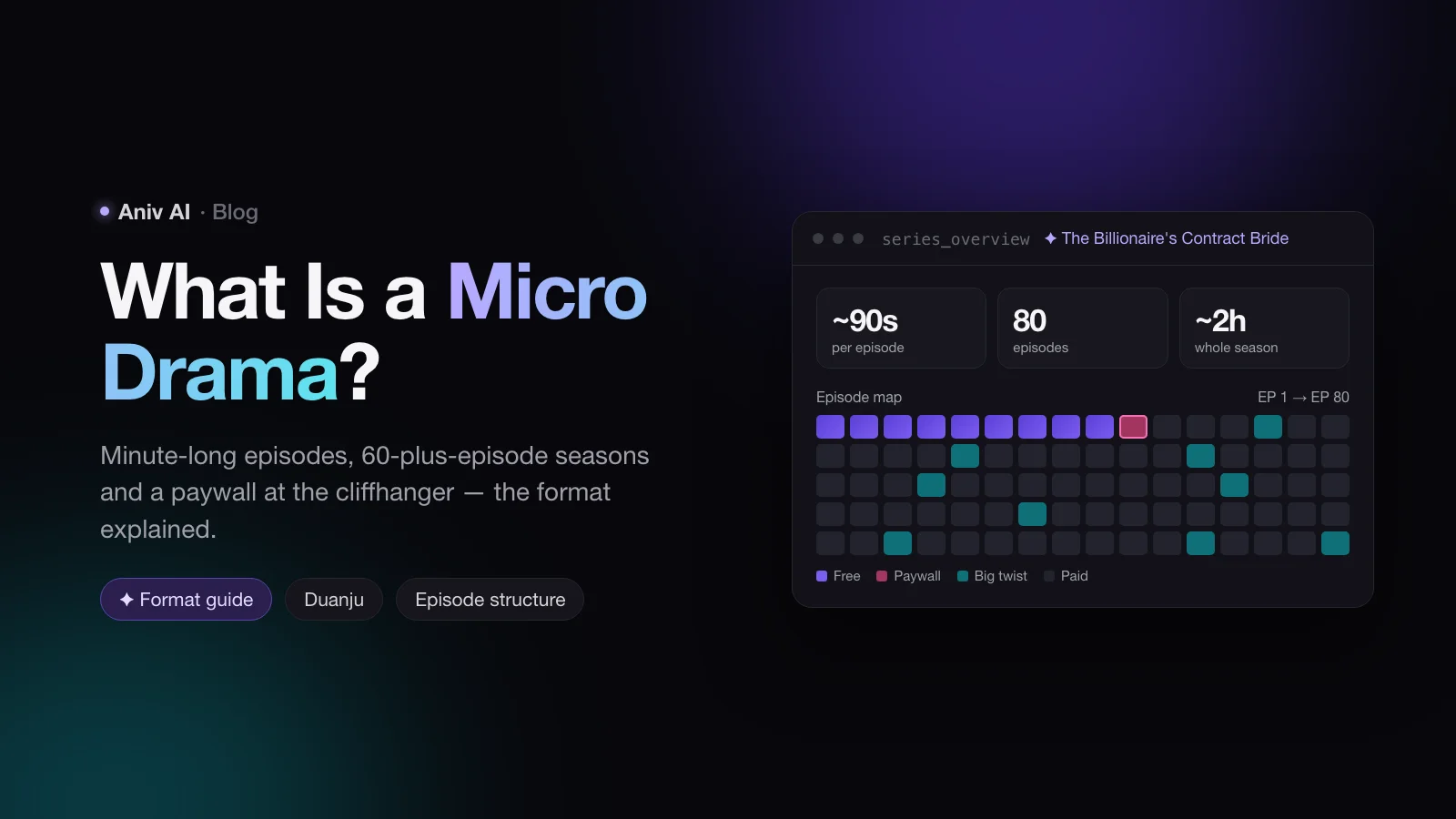
A micro drama (also written micro-drama or microdrama) is a scripted series made of very short episodes — usually one to two minutes each — designed to be watched on a phone, one episode after another. A season typically has 20 to 100 episodes, every episode ends on a cliffhanger, and the first few are free while the rest are unlocked by paying or watching ads.
It sounds like a niche. It is not. Micro dramas started in China, where they are called duanju, and grew into a business worth billions of dollars a year before spreading to the US, Europe, Latin America and Southeast Asia through apps like ReelShort and DramaBox. This guide covers what defines the format, how it compares to other kinds of drama, why it works commercially, and how micro dramas are produced — including with AI.
The micro drama format at a glance
- Episode length: about 60 to 120 seconds.
- Season length: 20 to 100 episodes, often released all at once.
- Screen: vertical 9:16, shot for phones — which is why the same shows are also called vertical dramas.
- Structure: a hook in the first seconds and a cliffhanger at the end of every episode.
- Business model: free opening episodes, then pay per episode with in-app coins, watch ads, or subscribe.
Put together, a whole season is about as long as a feature film, but it is designed to be consumed in bursts — on a commute, in a queue, before sleep — with the next episode always one swipe away.
Micro drama vs. web series vs. TV drama
Short episodes alone do not make a micro drama. Web series have been short for years. What is different is the combination of length, quantity and pace:
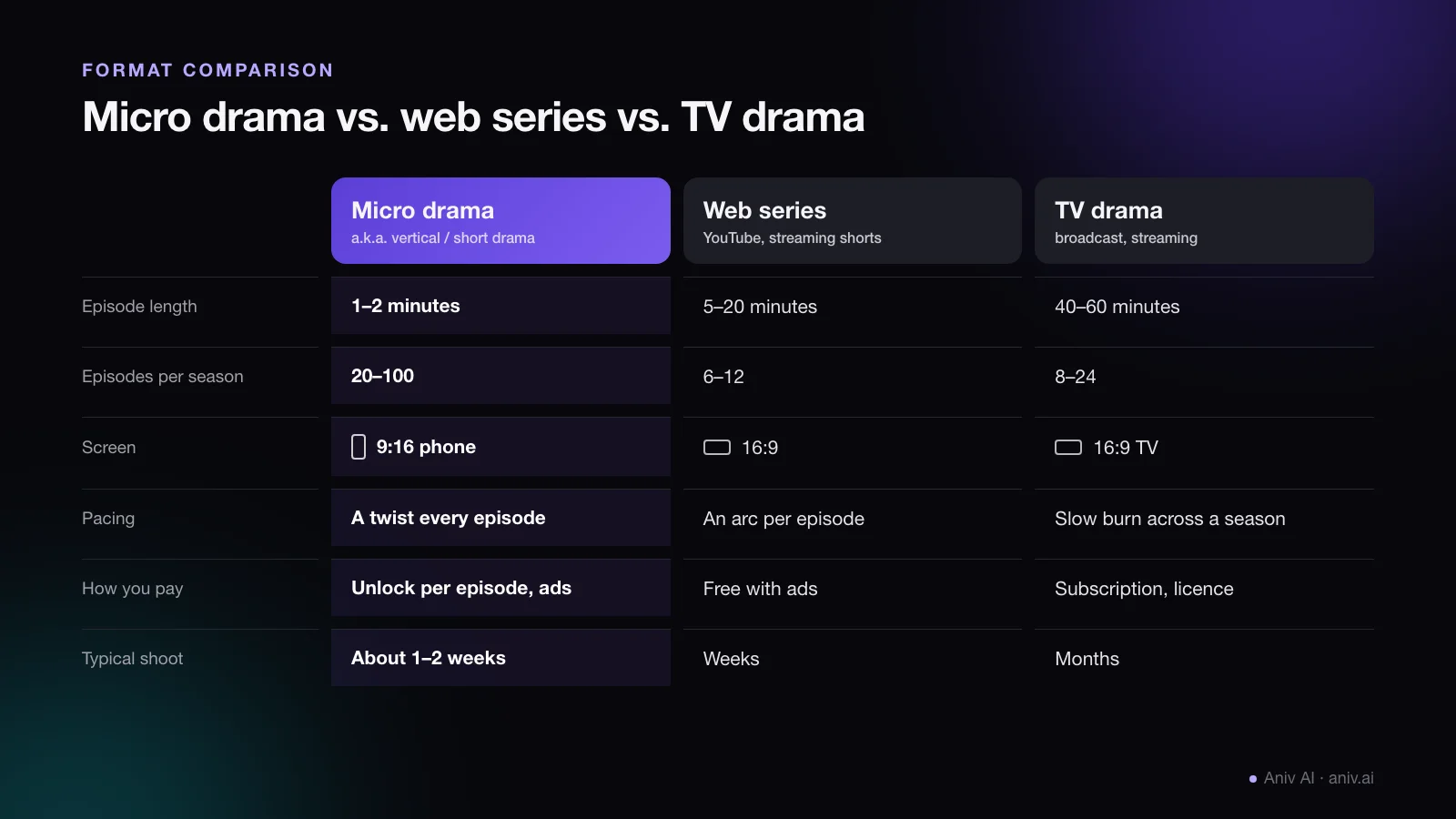
A TV drama builds tension slowly across a season of hour-long episodes. A web series usually tells a self-contained arc in each ten-minute episode. A micro drama compresses a full dramatic turn — setup, escalation, twist, cliffhanger — into about 90 seconds, and repeats it dozens of times.
What micro dramas are about
The stories borrow heavily from online romance and web fiction, where the formulas were already proven with millions of readers. The most common are billionaire and CEO romances, revenge stories, hidden identities (the mocked son-in-law who is secretly the heir), werewolf and fantasy romance, and family melodrama about swapped babies and inheritance.
The appeal is not surprise but payoff. Viewers know the cruel fiancé will be humiliated and the underestimated heroine will win; each episode exists to deliver one satisfying step toward that moment and then stop just before the next one.
Why micro dramas are a big business
The numbers explain why studios and investors have moved in:
- China's micro drama market passed 50 billion yuan (about 7 billion US dollars) in 2024, according to figures cited by People's Daily and CNBC, with hundreds of millions of viewers.
- Variety reported that ReelShort earned around 400 million dollars and DramaBox 323 million dollars in revenue in 2024.
- Industry estimates put the US, the largest market outside China, at about 1.3 billion dollars in 2025.
- Hollywood has followed: in 2025 Fox Entertainment agreed to fund more than 200 vertical series for the app My Drama, as reported by Deadline and Variety.
The economics work because production is cheap and fast compared with television, while the pay-per-episode model lets the most gripping shows earn far more per viewer than a subscription would. In the US, a whole series bought episode by episode can cost as much as a month of a major streaming service.
How a micro drama is structured
Every episode follows roughly the same five beats: a hook that pays off the last cliffhanger, a clear want, escalating pressure, a twist, and a new cliffhanger. Across the season, writers plan the biggest twist for the end of the free episodes, because that is where viewers decide whether to pay.
That makes micro dramas closer to serialised fiction than to film. The skill is less about a perfect single scene and more about sustaining a chain of small payoffs and questions for eighty episodes without repeating yourself. Our guide on how to write a drama script covers the episode beat structure and cliffhanger types in detail.
How micro dramas are made
Live-action production
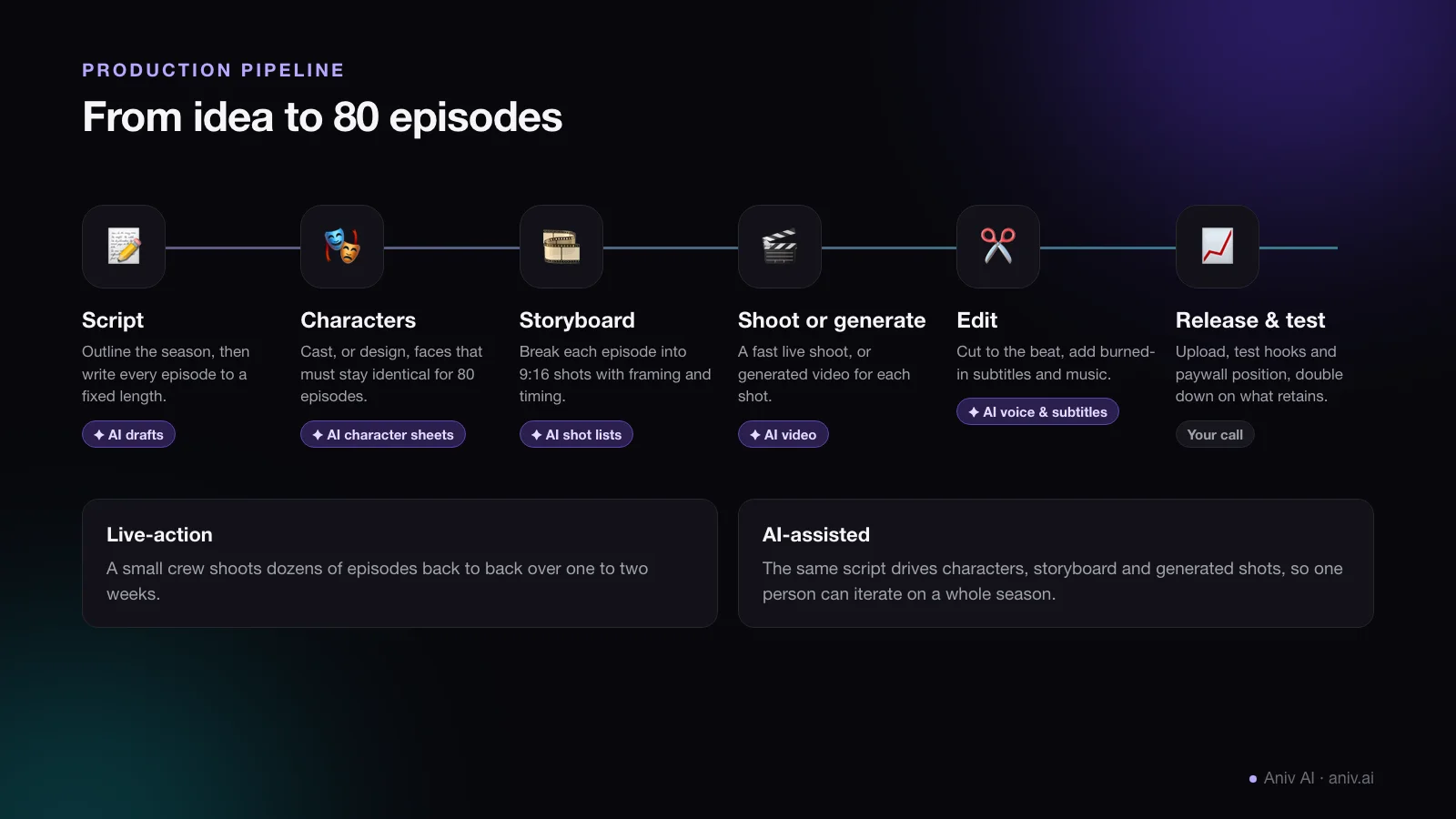
A typical US micro drama shoots 50 to 70 or more episodes in seven to ten days, on a budget of roughly 150,000 to 250,000 dollars, according to industry figures cited by Wikipedia. Chinese productions can be cheaper still. To hit that pace, a small crew shoots scenes out of order across a handful of locations, and the script is locked before the shoot begins — there is no time to rewrite on set.
AI-assisted production
AI changes the cost structure again. The hardest parts of a micro drama for a small team are keeping characters looking identical across dozens of episodes and producing hundreds of shots. Modern AI video tools address both: a script can drive consistent character designs, a shot-by-shot storyboard, voiced dialogue and generated vertical video, so a single creator can iterate on a whole season.
That is the workflow Aniv's AI short drama generator is built around. You start from an idea or paste your own script; Aniv generates the cast, scenes and storyboards, voices the dialogue and produces each shot as 9:16 video, and you manage every episode of the series in one workbench. Browse the showcases to see finished examples, or use the AI video generator for individual shots.
What still needs a human
- The premise and the twists. AI can propose dozens; deciding which one makes the story harder for the protagonist is a judgement call.
- Pacing the season. Where the free episodes end and which reveal to hold back is the core of the business model.
- Quality control. Generated shots need checking for character consistency, hands, lip sync and continuity between episodes.
Micro drama examples by genre
| Genre | Episode 1 hook | Free-episode cliffhanger |
|---|---|---|
| Billionaire romance | A waitress spills wine on a stranger, who turns out to be her new boss. | He proposes a contract marriage — and she discovers the contract names her missing mother. |
| Revenge | A wife is thrown out on her wedding anniversary. | She returns as the CEO of the company that just bought her husband's firm. |
| Hidden identity | A son-in-law is mocked at a family banquet. | The richest guest at the party bows to him. |
| Fantasy romance | A girl is rejected by her fated mate in front of the pack. | She wakes with powers no one in the pack has seen in a century. |
Frequently asked questions
What is a micro drama series?
A micro drama series is a complete story told in many very short episodes — usually 20 to 100 episodes of one to two minutes — filmed vertically for phones, with a cliffhanger at the end of each episode.
Is a micro drama the same as a vertical drama?
In practice, yes. "Micro drama" emphasises the episode length and "vertical drama" the 9:16 screen format; both describe the same kind of show, also called short drama or duanju.
Where can I watch micro dramas?
Mostly in dedicated apps such as ReelShort, DramaBox, ShortMax, GoodShort, FlexTV and My Drama. Some series are also posted on YouTube, TikTok and Dailymotion. The first episodes are usually free, with later episodes unlocked by coins, ads or a subscription.
How much does it cost to make a micro drama?
A live-action US production is commonly estimated at 150,000 to 250,000 dollars for a full series shot in about a week and a half. Productions in China and AI-generated series can cost much less, because there is no set, cast or crew to pay for every shooting day.
Can AI make a micro drama?
AI can now handle most of the production: drafting scripts, designing consistent characters, storyboarding, voicing dialogue and generating the video shots. The creative decisions — the premise, the twists and where to place the paywall — still benefit from a human. Tools like Aniv combine these steps so that one person can produce a full series.